Category Archives: Parshas Terumah

Parshas Terumah: Mission Impossible? Try It And See What You Think!

Parshas Terumah

Mission Impossible? Try It And See What You Think!
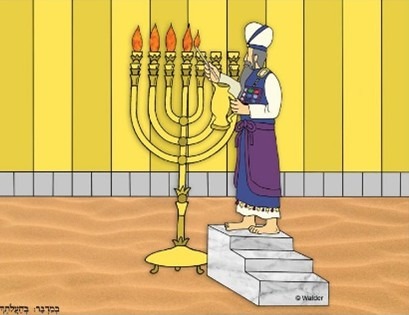
 

“You shall make a Menorah of pure gold. Hammered out shall the Menorah be made….” (Shmos 25:31) “Observe and make them according to the form that will be shown to you on the mountain.” (Shmos 25:40)

A King promised a great reward to anyone who would climb a ladder and reach the top of a certain tower. The challenge was that the ladder was several feet away from the top floor and the ladder was at an angle. It was a seemingly impossible task. The King insisted that anyone who tried should wear a certain helmet while climbing the ladder. The climb was difficult. Many who tried would get to a third of the way up the ladder or halfway up, look up and wonder why they were even bothering to try.  One after another, they gave up trying. One man was very determined. He climbed higher and higher, sweating profusely until he reached the top rung of the ladder. But he was still too far from the top floor. He did not know that there was a strong magnet on the top of his helmet as well as on the top floor. As soon as he reached the top rung, the magnet pulled him up the rest of the way. (Rabbi Frand in the name of Rav Gifter z t”l)

The pasuk (25:31) says, “תֵּיעָשֶׂה הַמְנוֹרָה”, The Menorah shall be made. Rashi points out that the passive form is used here instead of the the active form of “עָשָֹה” which is used in connection with the making of the other items of the Mishkan. Apparently, Moshe had difficulty visualizing how to make the Menorah. Hashem told him to throw the block of gold into fire and the Menorah would be made.

A later pasuk (25:40) says, “Observe and make the Menorah like the pattern that will be shown to you on the mountain.” Rashi explains that Moshe was puzzled as to how to make the Menorah. So Hashem showed him a fiery Menorah, illustrating how the Menorah should be made.

In one place Rashi says that the Menorah was made by itself. In another place, Rashi says that Hashem showed Moshe a picture of fire of how the Menorah should be made. Which actually occurred?

The Sfas Emes answers that both teachings are correct. Moshe could not figure out how to make the Menorah which was so intricate.  Some commentaries explain that Moshe’s difficulty was how to include all the deep and hidden spiritual meanings that the Menorah would represent. Hashem showed Moshe a picture in fire of how the Menorah should look. However, Moshe was still unable to make it. At that point, Hashem told Moshe to throw the gold into the fire and the Menorah would emerge.

The Sfas Emes asks, if Hashem saw that Moshe Rabbeinu was having difficulty constructing the Menorah, why didn’t Hashem immediately tell him to throw the gold in to the fire? Why did Hashem first have Moshe go through the process of seeing the fiery picture of the Menorah?

The Sfas Emes explains that this teaches us a very valuable lesson. The importance of learning Torah and growing in spirituality is about the process. Success is a gift from Hashem.

At times, understanding a part of the Torah or the ability to do a specific mitzvah seems to be overwhelming. How will I ever understand this? How will I ever be able to accomplish this? The answer is that all that we have to do is to try, to make the effort to succeed. The end result often “emerges by itself”, just as the Menorah did.

Similarly, the Maharal says that once one makes the effort, then Hashem is willing to help him succeed. But if a person sits back with folded hands and just waits for a miracle to happen, then it is not going to happen!

(based in part on Rabbi Yissoher Frand on Torah.org)


A few days after our forefather Avraham had his bris mila, he welcomed and cared for three travelers. Although the guests appeared to be Arabs, they were actually angels. The Talmud (Bava Metzia 86B) says that Avraham’s descendants were rewarded for each of his actions. When the Jewish People were in the desert, after leaving Egypt, they benefited from Avraham’s kindness. In reward for Avraham providing his guests with food, Bnei Yisroel were provided with the mann. In reward for Avraham providing them with water, Bnei Yisroel were provided with water from a well that traveled with them. In reward for Avraham standing over his guests to serve them, Bnei Yisroel were rewarded with the Clouds of Glory that protected them in the desert.

The basic understanding of this Gemorah is that because of Avraham’s actions, Bnei Yisroel were provided with these three miraculous gifts for the entire 40 years that they were in the desert! Maharsha says that in Avraham’s merit the Jews received these 3 initially. That itself was a significant reward for Avraham’s actions. However, for the remainder of the time that the Jews were in the desert, they received these 3 rewards in the merits of Moshe, Aharon, and Miriam. When Miriam died, the well of water disappeared. When Aharon died, the Clouds of Glory dissipated. When Moshe died, the Mann stopped falling.

Rav Michel Zilber in Bayam HaDerech (quoted by Rabbi Dovid Ashear in Living Emunah 2) asks why this particular act of hospitality by Avraham resulted in such an amazing reward. After all, Avraham’s entire life was devoted to hospitality and to bringing others to have an awareness of Hashem. Why was this particular act of hospitality so special? Furthermore, this act did not benefit anyone since these guests were angels and not people. Rabbi Zilber answers that the value of a mitzvah is not dependent upon the outcome but on the effort.  Avraham was 99 years old. He had his bris mila only 3 days prior and his pain was at its peak. The day was abnormally hot since Hashem had purposely made it so, to save Avraham from the trouble of giving hospitality while he was recovering from the bris mila. Due to all of this, Avraham’s efforts of hospitality on this particular day were extraordinary!  That is why his mitzvah was so valuable and that is why he was rewarded so greatly!

At times, one may put a lot of effort into trying to do a mitzvah while in the end, he is not successful in performing the mitzvah. One may spend weeks organizing a special shiur and only two people attend. One should not feel that his time was wasted! Hashem is not concerned about the results, but only the efforts!

Rabbi Henach Leibowitz zt”l used to say that our job is to teach Torah and try to bring Jews closer to Hashem. Whether or not we succeed is up to Hashem.

The value of our Torah learning and our other mitzvos, is not dependent upon the outcome.

Rather it is dependent on the effort that we invest into it.


Parshas Terumah – Shekalim: The Remedy Is Already Here!

Parshas Terumah – Shekalim

The Remedy Is Already Here!


“After these events King Achashverosh promoted Haman.” (Megillas Esther 3:1)

I read a story some time ago, but I do not recall the source.

Moshe & Leah were happily married. However, they were not blessed with children right away. In fact, five years passed, and they still did not yet have children. Imagine their excitement when Leah gave birth to a beautiful baby girl. Unfortunately, the baby was born with a serious blood disorder. The doctor told Moshe and Leah not to worry. He said that just a few months earlier, a cure had been discovered for this disorder. The doctor told them that they were lucky that the child had not been born six months earlier. Had the baby been born before the treatment was discovered, most likely the baby would not have survived. Now, Moshe & Leah were thankful to Hashem that they had to wait five long years before having a child.

We are currently living through a very trying time for Klal Yisroel, as a nation. We can take some comfort from the fact that Hashem has already prepared the remedy for our troubles, even before the troubles even began.

We see this idea from Megillas Esther. “After these events King Achashverosh promoted Haman.” (Megillas Esther 3:1). The Talmud (Megillah 13B) asks, “After what events? Rava answers, ‘Only after Hashem created a remedy for the blow and set in place the chain of events that would lead to the miraculous salvation was Haman appointed.”  Tze’enah Ure’enah says that the remedy was that first it was inscribed in the royal diary that Mordecai had saved Achashverosh from death. That was important for the ultimate salvation of the Jews. Only afterwards, was Haman raised to a high office, higher than all the other ministers.  Raish Lakish says that Hashem does not strike at the Jewish people unless He has already created a remedy beforehand. This rule is significant because it indicates that the objective of the punishment is the cure, to bring us to teshuvah and salvation. The cure is, therefore, always set in place first.

Haman asked Achashverosh for permission to destroy the Jewish People. Haman offered Achashverosh ten thousand talents of silver which were equal to 30 million shekels (valued today at approximately 725 million dollars) for the privilege to enact the decree (Megillas Esther 3:9). Haman gave this sum because it was equal to the monetary value of the entire Jewish nation. Haman knew that 600,000 Jewish men from the ages of 20 to 60 left Egypt. The Torah says that the evaluation of Jewish males in that age range is 50 shekalim (Vayikra 27:2). Multiplying 600,000 by 50 equals ten thousand silver talents (see Torah Temima). Raish Lakish says that Hashem knew in advance that in the future, Haman would use shekels against the Jewish people. Therefore, Hashem arranged for the Jewish people to give their own shekels to the Bais HaMikdash in advance of Haman’s shekels. This is another illustration that Hashem does not strike at the Jewish people unless He has already created a remedy for the Jewish People beforehand.

Maharal (sefer Ohr Chodosh on Megilllah 3:9) explains that the shekels that the Jews gave were used to purchase animals to sacrifice. Bringing a sacrifice is akin to one sacrificing oneself to Hashem. By giving the shekels, it was as if the Jews gave themselves to Hashem. If the Jews already belonged to Hashem, then Achashverosh did not have the authority to sell them to Haman for the 10,000 silver talents (“And the king said to Haman, The silver is given to you, the people also” (Megillas Esther 3:11)).


Parshas Terumah: How Much Money Do You Really Have?

Parshas Terumah

How Much Money Do You Really Have?

“Speak to Bnei Yisroel and let them take for Me a portion, from every man whose heart motivates him you shall take My portion.” (Shmos 25:2)

One of the Rothchilds was once asked how much wealth he had. He read from a ledger that had the list of his many donations to tzedakah and told the man the total of his “wealth”. His secretary thought he had taken out the wrong ledger and not the one that stated his wealth. Rothchild told him that it was true that he owned mines and property, …. However, that wealth was not guaranteed. The mines could be flooded, the properties could be confiscated, war could disrupt his business and render all his securities worthless. Only the money that he gave to tzedakah was really his and could never be taken from him. (Ethics From Sinai as quoted in Love Your Neighbor by Zelig Pliskin)

Hashem told Moshe to ask Bnei Yisroel for donations to build the Mishkan, the Tabernacle.

The commentators are bothered by the wording of the pasuk (Shmos 25:2). Why did Hashem say to Moshe to tell Bnei Yisroel,” וְיִקְחוּ־לִ֖יְ”, that they should take for Me their donations, rather than saying that they should give Me?

The Malbim explains that Hashem wanted the donations to be voluntary, stemming from the feelings of the heart. Had Hashem told Bnei Yisroel to give donations, that would have indicated that it was a mitzvah and obligation to do so. Therefore, the pasuk says, “that they should take for Me”. Representatives should be appointed to accept all donations from whomever desired to give.

HaKsav VeHaKabalah explains that when you are giving something to a distinguished person it makes you feel so good, it is as if you are receiving that item. HaKsav VeHaKabalah proves his point. When our forefather Avraham prepared food for his guests (the 3 angels who appeared as travelers), he said, “ואקחה פת לחם”, let me take some bread for you, instead of saying let me give you. Also, when Eliezer gave Rivkah the jewelry, he said, “ויקח האיש נזם זהב ושני צמידים”, he took jewelry, instead of saying that he gave (see Talmud Kiddushin, 42, for another proof).

The Beis Halevi (quoted in Talelei Oros by Rabbi Yissachar Dov Rubin) has a different explanation. He says that the only money that is truly ours is the money that we give to tzedakah. The money that we keep for ourselves is not really ours. We are simply holding it, for the time being. The Talmud (Bava Basra 11A) says that during the reign of King Munbaz (Rashi and Rabbeinu Gershom say that he was the son of Queen Helana, a descendant of the Chashmonim kings), there was a terrible famine. The king gave away his treasures and the treasures of his ancestors, distributing the money to the poor. His brothers and his father’s household joined together against him to protest his actions. They said to him, “Our ancestors stored up money in their treasuries and added to the treasures of their ancestors, and you are liberally distributing it all to the poor.” King Munbaz replied,” Not so. My ancestors stored up below, whereas I am storing above… My ancestors stored up treasures in a place where the human hand can reach, and so their treasures could have been robbed, whereas I am storing up treasures in a place where the human hand cannot reach, and so they are secure, … My ancestors stored up something that does not generate profit, as money sitting in a treasury does not increase, whereas I am storing up something that generates profit… My ancestors stored up treasures of money, whereas I am storing up treasures of souls… My ancestors stored up for others, for their sons and heirs, when they themselves would pass from this world, whereas I am storing up for myself… My ancestors stored up for this world, whereas I am storing up for the World-to-Come.”

There was a man who lived in the land of Israel who owned a very fertile field. Every year the field yielded 1,000 measures of wheat and every year he gave one tenth of that as ma’aser to the Leviim. Before he passed away, he exhorted his son to be heedful of giving ma’aser. He said that would guarantee the bountiful production of the field. The man passed away and his son inherited the field. At first, he gave ma’aser regularly. Then he started giving less and less ma’aser. Each following year that he gave less ma’aser, the field produced less. Eventually, the field only produced 100 shares instead of the original 1,000! (Midrash Tanchuma Parshas Re’eh, cited in Our Sages Showed the Way by Yocheved Segal).

The Sforno says (Devarim 14:22) when you give the Levi,ma’aser, a tenth of your crops of the fields and orchards as well as that of your livestock, you will actually increase their numbers This is what our chachamim, our sages, meant when they said in the Talmud (Shabbos 119) עשר בשביל שתתעשר, “Give the tithes so that you will be enriched.”

Who is truly wealthy?! Our wealth does not belong to us. We are only guardians of it. The only wealth that truly belongs to us is the money that we give to tzedakah or use for mitzvos.


Parshas Terumah: Hold the Poles and Soar to the Highest Heights!

Parshas Terumah

Hold the Poles and Soar to the Highest Heights!


“The poles shall be in the rings of the ark: they shall not be taken from it.” (Shmos 25:15)

Last year I visited Eretz Yisroel. I spoke with a rav who shared a fascinating, personal story. When he first got married, he was planning to learn in Kollel for a number of years. This was at a time when learning in Kollel was not a common practice. His father, knowing that he would need a means of support, offered to support him for five years even though it was not a common practice in those days. True to his word, the father supported the son for five years. The father died very shortly thereafter. The father had survived a heart attack right before he began supporting his son in Kollel and had a fatal heart attack right after ending his support. The son was told that it was likely that his father had been granted an extra 5 years of life in the merit of having supported his son’s Torah learning, during that time.   

The Alshich (Shmos 25:8) says that Hashem wanted the Jewish people to build a Mishkan in order that Hashem’s Holy Presence could dwell amongst them. The Mishkan was only a symbol for the true resting place of the Holy Presence, namely in the heart of every Jew. The Ba’al HaTurim (Shmos 25:2) says that we can make our heart a Mishkan for Hashem’s Holy Presence by devoting our heart to Torah and Hashem’s service. (The Midrash Says, on Shmos)

Learning Torah and doing mitzvos is our raison d’etre, our reason for living.

The Shulchan Aroch (Yorah Deah, Siman 246) states that every Jew is obligated to learn; be he rich or poor, healthy or suffering, young or old, rich or poverty stricken. All are obligated to set aside time for learning, both day and night. The Talmud (Megillah 10B) says that the Aron, the Holy Ark, miraculously took up no space in the Holy of Holies in the Bais Hamikdash. I believe that Rav Herschel Welcher said that one thing this teaches us is that when we set aside time to learn Torah, it does not take time out of our day. In the merit of our learning Torah, Hashem helps us to accomplish the other things we need to, more quickly than we would have otherwise been able to. Thus, our Torah learning doesn’t take away our time as Hashem facilitates our accomplishing more, in the same time.

Nowadays, even one who does not understand Hebrew can still learn Torah. There are many Torah classes given in English both live and on the internet (such as on Torahanytime.com). There are also many Torah books translated from Hebrew.

At times, there are extenuating circumstances which make it difficult for one to learn as much Torah as he would want to. The Chofetz Chaim zt”l  (Shem Olam, perek 14) says, if that would be the case, then one should support others who are learning. That will help him acquire his share in Torah and it will be considered as if himself had learned Torah.

It says in our parsha (Shmos 25:15) that the poles that were “used to carry the Aron were to remain and never be removed”.  When the Jews were camped and not travelling, the poles were not needed to carry the Aron. Yet, it was forbidden to remove them. The Chofetz Chaim zt”l (Shem Olam, 1:17) says this teaches us that the poles which were used to transport the Aron acquired the holiness of the Aron. It merited to be together with the Aron forever, even when it was no longer needed. Similarly, says the Chofetz Chaim zt”l, when you support someone who is learning Torah, you will merit to be alongside him in a very special place, in Olam Haba, the World to Come (quoted in Be’eru Chofetz Chaim on the Torah by Rabbi Yisroel Yosef Braunstein). Not only that, but when you support someone who is learning Torah, you will also understand the depth of learning just like the Torah learner, in the yeshiva shel malah, the Heavenly yeshiva.

When the Leviim carried the Aron by its poles, it appeared that they were carrying the Aron. The Talmud (Sotah 35A) says that actually, the Aron carried its bearers. Rabbi Nosson Adler zt”l says, this is similar to two people who make a Yissachar-Zevulun pact. In that pact, the “Zevulun” works and shares his salary with the “Yissachar” who devotes his time to learning Torah. Outwardly, it seems as if the “Zevulun” is supporting the “Yissachar”. That is not so. In actuality, the Torah of the “Yissachar” supports the “Zevulun”, just as the Aron carried its bearers. (Talelei Oros by Rabbi Yissachar Dov Rubin)

We are in this world for the sole purpose of learning Torah, doing mitzvos, and perfecting our character.

It is a tremendous merit to support those who are occupied with learning Torah.

We also personally gain great benefits, by doing so.