Parashas Chayei Sara
To Water Or Not to Water, That is The Question
“And Avraham gave all that he had to Yitzchak.” (Bereishis 25:5)
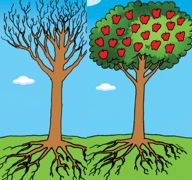
Bereishis Rabba (61:6) cites Rabbi Chama who said that Avraham bequeathed to Yitzchak gifts but not blessings. This is analogous to a king who had an orchard, which he gave over to a sharecropper. In the orchard there were two trees that were intertwined. One tree produced life-giving fruits and the other produced poisonous fruits. The sharecropper had a dilemma. If he would water the tree that bears life-giving fruits, then the one that bears poisonous fruits would also be watered and would also grow. However, if he refrained from watering the poisonous tree, how would the tree that produced life-giving fruits survive? He decided that since he was just a temporary sharecropper, he would leave the decision to the owner of the orchard. Similarly, Avraham felt that if he would give the blessings to Yitzchak then Avraham’s other sons, Yishmael and the sons of Ketura would also want to be included in the blessings. If he would not bless Yishmael and the sons of Ketura, then how could he bless Yitzchak? Avraham solved this dilemma. He said, “I am flesh and blood. I am here today and tomorrow [in the future] I will be in the grave…. What Hashem wishes to do in His world, let Him do.” Later, when Avraham died, Hashem revealed himself to Yitzchak and did give him the brachos (Bereishis 25:11).
According to the Midrash, Avraham refrained from giving the brachos to Yitzchak because he did not want to give those brachos to his other sons. If Avraham had just given the brachos only to Yitzchak, then Avraham’s other sons would have felt pain and anguish. Avraham did not want to cause them pain and anguish, so he left the decision about the brachos up to Hashem.
Avraham’s action is incomprehensible! The blessings that we are referring to, was the power to give brachos to anyone. That was a legacy (see Rashi, Bereishis 12:2) that was vital to the future success of the Jewish People. In fact, it was those selfsame blessings that Rivkah wanted Yaakov to receive from Yitzchak. Both Rivkah and Yaakov put their futures in danger to attain those brachos. Their attempt to get the brachos could have led Yitzchak to curse them, had he felt that their actions were not proper. When Esav heard that Yaakov had received those blessings, he cried bitterly. Clearly, the blessings were of vital importance! Wasn’t Avraham obligated to insure the future and the success of the Jewish People? How could he shirk his responsibility just because his action might have caused some pain to Yishmael and Avraham’s other sons from Ketura?
We learn an extremely important lesson from Avraham’s actions. The end does NOT justify the means! Avraham’s obligation was to do the right thing, to follow the dictates of halacha and to follow the will of Hashem. The right thing in this situation was not to cause pain to others. What about the legacy and future of the Jewish People? The answer is that Hashem runs the world and if Hashem wanted the Jewish People to have those brachos then He would ensure that they would get them. Which Hashem did.
We see the same idea illustrated in the Talmud (Brachos 10A). When King Chizkiyahu became deathly ill the prophet Yeshayahu came to him with a message from Hashem. “Set your house in order, for you will die and you will not live” (Yeshayahu 38:1). This repetition meant that he would die in this world and he would not have a share in the World-to-Come. King Chizkiyahu asked what he did wrong to deserve such a punishment. Yeshayahu told him that he sinned by not fulfilling the mitzvah to try to have children. King Chizkiyahu explained that the reason he did not marry and try to have children was that he foresaw with Divine inspiration, that he would father a very evil child, Menashe, who would cause the Jewish People to sin. Menashe would restore idolatry and would even place idols in the Beis HaMikdash! Therefore, King Chizkiyahu thought it was preferable not to father any children.
Yeshayahu told him that his job was to follow Halacha, Jewish law, as per Hashem’s will. Hashem gave the mitzvah to have children and that was King Chizkiyahu’s obligation. The type of children he would have was up to Hashem. Hashem has secretive reasons why certain things happen. Our job is, and King Chizkiyahu’s job was, not to question Hashem’.
The story continues that King Chizkiyahu said to Yeshayahu to give him his daughter as a wife. He said that maybe their combined merits will help him to father only virtuous children. Yeshayahu told him that it was too late, for the decree of death could not be changed. King Chizkiyahu responded that he had a tradition from King David that even if a sharp sword rests upon a person’s neck, he should not hold himself back from praying for mercy. One may still hold out hope that his prayers will be answered. King Chizkiyahu davened wholeheartedly and with intense concentration. Hashem accepted his tefillos and he did not die. He did what Hashem wanted him to do. Unfortunately, he did father an evil son but that was what Hashem wanted. That was part of Hashem’s overall, secretive plan.
At times we may want to do a noble action which will greatly benefit the Jewish People. However, if we would have to ignore the halacha to do so, we may NOT do it! We may think that our actions will be so beneficial that it’s okay to ignore the halacha. That is wrong! That is not what Hashem wants. Hashem wants us to follow halacha and do the proper action. But maybe the Jewish People will lose out? Maybe yes and maybe no. Hashem runs the world and has many ways to benefit us, if Hashem desires. The main thing is for us to do the right thing!
The end does not justify the means!!
(based on a dvar Torah by Rabbi Henach Leibowitz zt”l)


