Parshas Ekev
Smash!
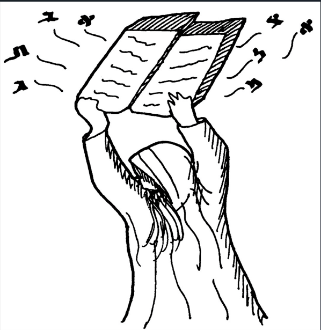
“I grasped the two tablets and threw them from my two hands and smashed them before your eyes.” (Devarim 9:16)
I remember reading a story about a famous Rosh HaYeshiva who was teaching a very complicated shiur. At one point, someone asked a question. The Rosh HaYeshiva thought about the question and said that you are correct and my premise is wrong. Whereby, the Rosh HaYeshiva closed his Gemorah and ended the shiur.
A couple called Rabbi Yisroel Brog for advice. The wife had a good job. Her salary was needed to help pay the family’s bills. The problem was that her working environment was not morally conducive for a religious woman. Rabbi Brog told the couple that Hashem would not want her to stay in that situation and that she should quit her job. Rabbi Brog said that Hashem would help her find another job. She quit her job. Eventually she got a better paying job working in a Jewish environment.
Moshe Rabbeinu was reviewing with Klal Yisroel past events. Moshe indicated that when he had seen the Jews sinning with the golden calf, he smashed the luchos that he had been about to present to Bnei Yisroel. The last pasuk in the Torah says, “And for the entire strong hand and for the entire great display that Moshe performed in view of all of Yisroel.” Rashi explains that this is listing Moshe’s outstanding achievements. Moshe brought down the Torah to Bnei Yisroel from the Heavens. Moshe also performed many miracles in the desert during the 40 years that the Bnei Yisroel were there. The 3rd achievement was that Moshe’s heart inspired him to shatter the luchos before their eyes. Mizrachi adds that these were the luchos which were the handiwork of Hashem. They were magnificent! Yet, Moshe smashed them! And Hashem congratulated Moshe for doing so.
Rabbi Yissocher Frand explains that this achievement of breaking the luchos was considered Moshe’s crowning achievement. Why was breaking the luchos Moshe’s definitive achievement, even more so than receiving the Torah? Rabbi Yissocher Frand answers that Moshe put in Herculean effort to receive the Torah. He did not eat for 40 days and 40 nights while Hashem taught him the Torah. And, he had to battle the angels who didn’t want to give up something so precious to a person of flesh and blood. Moshe had a reason why he felt that the right course of action was to break the luchos. Even so, destroying something in which one put in so much effort is very difficult. Yet Moshe did it! For that, Moshe received high praise.
Rabbi Mordechai Gifter zt”l expressed a similar thought from the Talmud (Pesachim 22B).
It says the word “אֶת” in the Torah about 4,000 times. A tanna, a rabbi of the Mishna, Shimon Ha’amsuni said that each pasuk could have been written, leaving out the word “אֶת”. Thus, each time that the Torah says the word “אֶת” it always implies the inclusion in the particular subject matter something which is not mentioned expressly in the text. Shimon Ha’amsuni spent many years delving into the psukim and expounding on what the Torah was teaching with each “seemingly extra” word “אֶת”. One example is that when, the Torah says (Shmos 20:12), “כַּבֵּד אֶת אָבִיךָ וְאֶת אִמֶךָ”, “Honor your father and your mother”. Shimon Ha’amsuni taught that the extra word, אֶת, teaches that one should also honor his older siblings. When Shimon came to the pasuk, “אֶת ד’ אֱלֹקֶיךָ תִּירָא”, “Fear Hashem, your G-d” (Devarim 6:13), he was stymied. He could not understand what the extra word “אֶת” could be adding. He felt that it was impossible to feel awe of another human being alongside Hashem. Because of this one “אֶת” that had stumped him, Shimon concluded that his entire hypothesis was incorrect, and the word “אֶת” is not always teaching something new! Therefore, Shimon withdrew all his earlier deductions. Shimon’s students asked him what would happen to all the other explanations of the word “אֶת” that he explained until now. Shimon haAmsuni responded, “Just as I have earned reward for my interpretations, so too shall I earn reward for withdrawing.”
Shimon was willing to give up his Magnum Opus, his life’s work, for the sake of intellectual honesty.
The Talmud (Bava Kama 41B) says that eventually Rabbi Akiva was able to deduce what the word “אֶת” in this pasuk was teaching. Thus, he proved that Shimon Ha’amsuni’s hypothesis was correct. Rabbi Akiva said it teaches that one is required to be in awe of talmidei chachamim as a corollary to one’s awe of Hashem! The reverence one must have for Torah scholars is like the reverence one must have for Hashem!
The question is why didn’t Shimon Ha’amsuni also deduce from the word, “אֶת”, the same thing that Rabbi Akiva expounded? Ben Yehodaya answers that Hashem hid this explanation from Shimon to reward him for his revoking his life’s work. Shimon gave it up for the honor of Hashem, so as not to give an incorrect explanation of the Torah. That was very special to Hashem and Hashem wanted to reward Shimon for it! (Ben Yehodaya gives a 2nd answer that it was for Rabbi Akiva’s benefit…)
What is the explanation of why one should revere a Torah scholar just as one is supposed to fear Hashem? Why did Rabbi Akiva think it was proper to place a human authority side by side with Hashem?
Sefer Hamussar (The Pirkei Avos Treasury by Rabbi Moshe Lieber on Pirkei Avos 4:15) answers that one achieves life in the World to Come through the teachings of the Torah scholars. Therefore, one should revere them.
The Dubno Maggid gives a similar answer by way of a moshol (The Maggid of Dubno and His Parables by Benno Heinemann). There was once a blind man who had to travel constantly to earn a living. He had a friend who always went with him, as a guide. Whenever the blind man traveled outside the country, he carried a safe-conduct pass permitting him to leave the country and to return. Once, when returning to the country, the blind man and his guide were stopped by the border guard who asked to see their papers. The blind man took out his own safe-conduct pass. Then the border guard asked to see the guide’s papers. The guide had none. The blind man said that his guide did not need any papers since he was included in his. The border guard looked again at the blind man’s papers but did not see the guide’s name listed. The blind man explained that his document permitted him to travel abroad to pursue his livelihood. The blind man continued and said that obviously a blind man cannot travel alone. Thus, obviously his document, by implication, included the guide as well.
The Dubno Maggid continued that the pasuk tells us to fear Hashem. How does one attain that since one is “blind” in that area, not knowing what to do. One must have a guide to teach him what to do. The guides are the talmidei chachamim, the Torah scholars. Thus, they are included by implication in the word “אֶת”. Proper respect for them is an essential part of fearing Hashem. If we do not take them as guides, we would never know how to fear Hashem.
Rabbi Gifter zt”l gave a different answer as to why Shimon Ha’amsuni could not come to the same conclusion as Rabbi Akiva. Rabbi Gifter z t”l says that Rabbi Akiva saw Shimon Ha’amsuni. He saw a talmud chacham who devoted himself to a major project. Yet, when he found that he could not explain the word “אֶת” just one time, he was willing to backtrack and give up the entire project! Rabbi Akiva saw a person so committed to the truth and one who was willing to give up so much by admitting that his life’s work was all mistaken. Thus, Rabbi Akiva said that this person is worthy of our awe.
Based on this, Rabbi Frand asks some powerful questions we should ask ourselves. “Am I compromising on my values? Am I making good choices in my life or am I making excuses for bad behavior? Is the way I act among secular colleagues acceptable for a religious person? Should I continue working in a place where my spirituality is being tested daily? Is running my business requiring access to forms of media that I should not be viewing or reading?” These are difficult questions that we must ask ourselves since it could mean walking away from something, in which we have invested tremendous effort in achieving. If we do that which we know that Hashem wants and we walk away from making the wrong choices, then Hashem will reward us! (based in large part from Rabbi YIssocher Frand, The Power of a Vort)


